ISO 45001 Internal Auditor Training for Occupational Health and Safety Management Systems (OHSMS)

ISO 45001 Internal Auditor Training is for anyone that wants to learn how to be part of the audit team that conducts an ISO 45001:2018 Internal Audit (for Occupational Health and Safety Management Systems).
Our blended learning course is a hybrid approach where learners first complete eLearning modules on the underlying theory that better prepares learners in advance of attending Live Classes with an experienced Instructor. Our live workshops are based on practical training methods with real-world examples, case studies, facilitated exercises and group discussions.
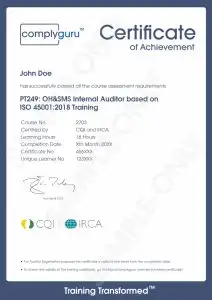
CQI and IRCA certify this course (No. 2703) offering global recognition for successful participants.

Overview of our ISO 45001 Internal Auditor Training






What's covered on our ISO 45001 Internal Auditor Training
Learners first complete interactive eLearning modules to grasp the underlying theory, then attend live, instructor-led workshops emphasizing practical, real-world application.
- What is an Occupational Health & Safety Management System (OHSMS)
- Purpose, Benefits and Structure of ISO 45001
- ISO 45001 Terms and Definitions
- Plan Do Check Act
- Documented Information
- Risk Based Thinking
- Management Commitment
- Management System Audits
- Audit Terminology
- Principles of Auditing
- Audit Program Management
- Audit Lifecycle
- Audit Planning
- Audit Objective, Scope and Criteria
- Selection of Audit Team and Leader
- Audit Initiation
- Audit Checklist Tools
- Document Review
- Audit Preparation Activities
- Internal Audit Plan
- Audit Checklist
- Opening Meeting
- Communication during the Audit
- Collecting & Verifying Information
- Audit Findings
- Non-Conformity Grading
- Document Review
- Non-Conformity Reporting
- Closing Meeting
- Audit Report
- Audit Follow Up Activities
Course Introduction
Practical Workshop Documentation Review – Audit Plan
Practical Workshop Audit Checklist
Practical Workshop Opening Meeting
Practical Workshop Simulated Case Study
Practical Workshop Generating Audit Findings
Practical Workshop Closing Meeting, Audit Report & Follow-Up

Kristian Hill
On completion of this course, successful Learners will have the practical knowledge and be able to apply the techniques needed to:
- Explain the purpose of an occupational health and safety management system, of management systems standards, and the business and societal benefits of improved performance given by an effectively implemented health and safety management system (OHSMS)
- With reference to the PDCA cycle, explain the process-based OHSMS Model for ISO 45001 and the role of an internal auditor in the maintenance and improvement of Occupational Health and Safety Management Systems
- Explain the role and responsibilities of an auditor to plan, conduct, report, and follow up an internal audit in accordance with ISO 19011

CQI & IRCA certify this course (No. 2703). Upon successful completion, each Learner shall receive a digital Certificate of Achievement within 1 business day.
Before completing this course, each Learner should have the following prior knowledge:
- It is recommended that anyone wishing to attend this course has some work-based experience in Health & Safety Management (based on ISO 45001)
- Knowledge of the requirements of ISO 45001:2018 and the commonly used terms associated with each standard is a key pre-requisite in attending this course.
- Knowledge of ISO 45001:2018 may be gained by completing a relevant Foundation training course or equivalent
- The Plan, Do, Check, Act (PDCA) Cycle
- The core elements of a management system and the interrelationship between top management responsibility, policy, objectives, planning, implementation, measurement, review and continual improvement.
- The concepts of managing occupational health and safety through hazard identification, risk assessment and risk control and compliance with legal requirements and other requirements.
- The relationship between occupational health and safety management and the provision of safe and healthy workplaces, the prevention of work-related injury and ill health, and the proactive improvement of health and safety performance.
- Common examples of relevant national and local OH&S legislation and requirements
Fluency in spoken and written English
- For participants whose first language is not English, we recommend a minimum English language competency of IELTS 5.5 (or equivalent) for successful completion of the program. This is not assessed by Comply Guru in advance & each participant must self-assess their competency.
Copy of ISO 45001 (International Standard)
- It is recommended that each Learner should have a copy of ISO 45001:2018 (International Standard) to reference while completing this course. This is not provided by Comply Guru and without it, this course will be challenging to complete successfully.
In order to successfully complete this course, each Learner will need to:
- Complete the eLearning modules and obtain 70% or higher in the final assessment to be eligible to attend the live workshops
- Maintain 100% attendance & achieve 70% or higher in the continuous assessments during the live workshops
For the live workshops during a virtual delivery, we utilize Microsoft Teams and SharePoint.
Learners need to individually have:
- PC or MAC Computer
- Reliable Internet
- Video Webcam
- Headset or Earbuds
- Quiet Setting
In relation to the eLearning Modules, in our experience, Workplace IT environments’ internal configurations and available software can vary (new or old), and there may be various limitations or other restrictions in place, and as such, the functionality of any Learning Management System (LMS) may be impacted, restricted and may not perform well. Read the full technology requirements here.
Need Corporate, In-House or Customized Training?
Comply Guru offers corporate, in-house and customized training solutions for your organization’s specific needs.
Speak with an experienced member of our team today to learn how we can help.
Frequently Asked Questions
Blended learning is a hybrid methodology where learners first complete eLearning modules on the underlying theory in advance of Live Workshops facilitated by an experienced Instructor.
This introduces more flexibility vs traditional learning by reducing ‘fixed’ classroom hours by up to 50%. In addition, improved learner confidence & preparation from the eLearning leads to better learning outcomes during the skills-based workshops.
Yes, very practical. Our live workshops are based on the principles of Accelerated Learning (AL). AL is based on ‘learn by doing’ through practical training methods which include real-world examples, case studies, facilitated exercises and group discussions.
We are passionate about ‘No Death by PowerPoint’ or a ‘sit and listen’ methodology. In fact, there are no slides during the live workshops. Come prepared to be fully engaged and of course, to learn a lot!
Yes, we can deliver training in-person or onsite for in-company groups. However, all our public training is delivered virtually. If you prefer in-person training, get in touch, we are happy to help.
Yes, we offer in-company training provided you have 5 or more learners that can be trained together on the same dates. Please request a quote and a member of our team will be in touch to discuss this further with you.
The eLearning unlocks up to 30 days in advance of the scheduled workshop(s). This is intentional. The modules are designed for learning to be achieved in the weeks leading up to live workshop(s) to ensure continuity in learning.
Once you have successfully completed the training, including all assessments, your certificate will be available within 1 business day. To access your certificate, you must first submit a short course survey and then the certificate will be available for download/print.
Please note: no certificates are available without full payment on file.
Yes, we permit substitutions provided the license has not been activated, the substitute meets the entry criteria and there is sufficient time available for the replacement to complete the mandatory eLearning and assessments. There is no fee for substitutions.
If the workshop is delivered virtually, there will be a link on your Learner dashboard. This link will become a visible two days in advance of the start date. In addition, a calendar invite is issued.
The eLearning modules, including assessments, form a mandatory part of the training. To be eligible to attend the live workshop(s), these must be successfully completed in advance of the specific deadline date for your registered workshops(s).
Note: if the eLearning modules and assessments are not successfully completed by the deadline, you will not be eligible to attend the live workshops. No refunds are possible when you fail to complete the eLearning on time.
Yes, we permit transfers to a future date (s) provided the request is made at least 30 days in advance of the live workshops you registered for. No refund is possible if less than 30 days’ notice is given. On a case-by-case basis, if we can accommodate a transfer at less than 30-days notice, we will but this cannot be guaranteed.
Comply Guru do not provide learners with copies of international standards, nor do we require that any purchase is made. However, participants do need to have access to a copy of required standard(s) on this training.
Firstly, we suggest seeing if you can obtain a copy of the required standard(s) from a friend, colleague or at your workplace. If you are unable to do so, each country has a nominated ISO standard supplier where you may purchase the international standard(s) you need for your training.
The eLearning duration provided is an estimate based on the average amount of time it takes a learner who is new to the subject/topic. In reality, the amount of time it takes to complete the eLearning will vary depending on your prior experience, knowledge & learning style.
No, there is no end of course examination. However, you must attend 100% of the live workshops and obtain 70% or higher in graded exercises during the live workshops in order to receive certification.
Blended Learning is Better Learning
Training Transformed with Comply Guru


Related Training Courses